Lab Detail
| Sno | Back | Back Subject | subject | date | title | note |
|---|---|---|---|---|---|---|
| 1 | 1 | Back to subject | AI for Image Analysis - 20A30702b (Theory) | Sept. 1, 2025 | Unit -3 Scikit Image | Scikit Image: Uploading and Viewing an Image, Getting Image Resolution, Looking at Pixel Values, Converting Color Space, Saving an Image, Creating Basic Drawings, Doing Gamma Correction. Rotating, Shifting, and Scaling Images, Determining Structural Similarity.
Uploading and Viewing an Image
Getting Image Resolution
Looking at Pixel Values
Converting Color Space Some color spaces (channels)
Some color spaces (channels)
The following represents a few popular channels/color spaces for
an image: RGB, HSV, XYZ, YUV, YIQ, YPbPr, YCbCr, and YDbDr. We can use Affine
mappings to go from one color space to another. The following matrix represents the linear
mapping from the RGB to YIQ color space:
Converting from one color space into another
We can convert from one color space into another using library functions; for example, the
following code converts an RGB color space into an HSV color space image:
Saving an Image
Creating Basic Drawings
Doing Gamma Correction POWER – LAW TRANSFORMATIONS:
There are further two transformation is power law transformations, that include nth
power and nth root transformation. These transformations can be given by the expression:
s=crγ
This symbol γ is called gamma, due to which this transformation is also known as
gamma transformation.
Variation in the value of γ varies the enhancement of the images. Different display devices
/ monitors have their own gamma correction, that’s why they display their image at different
intensity
where c and g are positive constants. Sometimes Eq. (6) is written as S = C (r +ε) γ to account for an offset
(that is, a measurable output when the input is zero). Plots of s versus r for various values of γ are shown in
Figure. As in the case of the log transformation, power-law curves with fractional values of γ map a narrow
range of dark input values into a wider range of output values, with the opposite being true for higher values
of input levels. Unlike the log function, however, we notice here a family of possible transformation curves
obtained simply by varying γ.
In Fig that curves generated with values of γ>1 have exactly The opposite effect as those generated
with values of γ<1. Finally, we Note that Eq. (6) reduces to the identity transformation when
c=γ=1.
 Fig: Plot of the equation S = crγ for various values of γ (c =1 in all cases).
This type of transformation is used for enhancing images for different type of display devices. The
gamma of different display devices is different. For example Gamma of CRT lies in between of
1.8 to 2.5, that means the image displayed on CRT is dark.
Varying gamma (γ) obtains family of possible transformation curves S = C* r γ
Here C and γ are positive constants. Plot of S versusr for various values of γ
is γ > 1 compresses dark values
Expands bright values
γ< 1(similar to Logtransformation)
Expands dark values
Compresses bright values
When C = γ = 1 , it reduces to identity transformation .
Rotating, Shifting, and Scaling Images
Representing Digital Images:
The result of sampling and quantization is matrix of real numbers. Assume that an image
f(x,y) is sampled so that the resulting digital image has M rows and N Columns. The values of
the coordinates (x,y) now become discrete quantities thus the value of the coordinates at orgin
become (X,y) =(0,0) The next Coordinates value along the first signify the image along the first
row. It does not mean that these are the actual values of physical coordinates when the image
was sampled.
  Thus the right side of the matrix represents a digital element, pixel or pel. The matrix can be
represented in the following form as well. The sampling process may be viewed as partitioning the
xy plane into a grid with the coordinates of the center of each grid being a pair of elements from
the Cartesian products Z2 which is the set of all ordered pair of elements (Zi, Zj) with Zi and Zj
being integers from Z. Hence f(x,y) is a digital image if gray level (that is, a real number from the
set of real number R) to each distinct pair of coordinates (x,y). This functional assignment is the
quantization process. If the gray levels are also integers, Z replaces R, the and a digital image
become a 2D function whose coordinates and she amplitude value are integers. Due to processing
storage and hardware consideration, the number gray levels typically is an integer power of2.
L=2k
Then, the number, b, of bites required to store a digital image is b=M *N* k When M=N, the
equation become b=N2 *k
When an image can have 2k gray levels, it is referred to as “k- bit”. An image with 256 possible
gray levels is called an “8- bit image” (256=28 ).
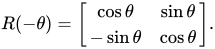
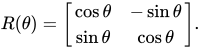
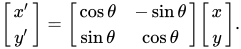
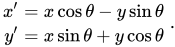
Rotating In linear algebra, a rotation matrix is a transformation matrix that is used to perform a rotation in Euclidean space. For example, using the convention below, the matrix Clock Wise Anti - Clock Wise This rotates column vectors by means of the following matrix multiplication, Says For ClockWise Rotation
Shift An Image
Cal :
Determining Structural Similarity (SSIM)
|